The evaluation of diamonds is essentially about investigating the 4C’s – Cut, Color, Clarity and Carat. KRÜSS gemstone microscopes provide gemmologists and dealers with a tool that goes far beyond the classic 10x magnification of a loupe. This guarantees evaluations at a high and professional quality level.
Why gemstone microscopes are indispensable for diamond valuation
A certified assessment can provide reassurance for buyers, especially when purchasing particularly valuable diamonds. Only under a gemstone microscope can the fine characteristics be identified that determine a diamond’s quality and price.
You are currently viewing a placeholder content from YouTube. To access the actual content, click the button below. Please note that doing so will share data with third-party providers.
More InformationKRÜSS stereo microscopes in practice
Our gemmological specialist, Dimitri Zlatev, demonstrates how the 4C diamond evaluation (Cut, Colour, Clarity and Carat) is carried out. He explains in particular the five factors of clarity grading: inclusion size, number of features, inclusion position, type/nature of the inclusion, and relief/visibility.
All of Dimitri’s videos can also be seen on our YouTube channel.
KRÜSS Gemmo-Shop: Example products gemstone microscopes
-
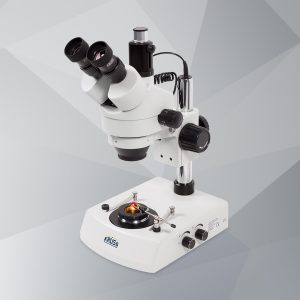
Gem microscope zoom
1.041,00 €Powerful stereo microscope with a large zoom range and long working distance, enabling observations with high technical prerequisites
excl. VAT
+ Shipping costs
Add to cart -
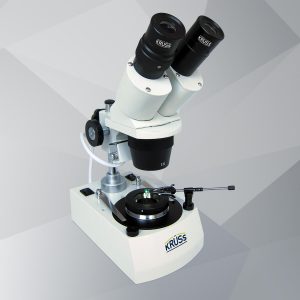
Gem microscope
427,00 €Microscope with incident and transmitted light, dark-field illumination (dark-field condenser), ideal for viewing outlines of low-contrast inclusions
excl. VAT
+ Shipping costs
Add to cart -
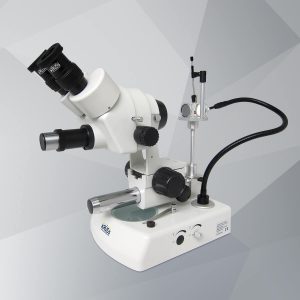
Stereo gemstone microscope
2.500,00 €Microscope can be tilted up to 38°; illumination: transmitted light & dark-field, LED gooseneck, fluorescent lamp; for viewing inclusions or color zoning
excl. VAT
+ Shipping costs
Add to cart
Recommended standards and quality criteria for diamond grading
Clarity grades FL/IF–VS (flawless to very small inclusions) are determined as follows:
Almost every diamond contains natural inclusions. Stones with clarity grades FL appear flawless at 10x magnification, IF (Internally Flawless) are internally flawless and VS diamonds show very small, difficult‑to‑detect features. Experts use diamond loupes for the initial inspection. For professional grading or certification, our high‑quality stereo microscopes are widely used. For optimal handling during microscopy, we recommend using premium KRÜSS Optronic tweezers.
You are currently viewing a placeholder content from YouTube. To access the actual content, click the button below. Please note that doing so will share data with third-party providers.
More InformationKRÜSS stereo microscopes in practice
Untrained diamond assessment can lead to misdiagnosis. An experienced gemmologist knows the typical pitfalls – and Dimitri Zlatev demonstrates this impressively using the example of supposed inclusions.
The video reveals that the initial assessment of “inclusions” is misleading. In reality, there are multiple reflections in the pavilion facets that look like inclusions.
The result: what looks like a quality defect is actually an optical effect.
Clarity grade: Flawless
The GIA awards the grade Flawless only when no internal or external features are visible under 10x magnification with a loupe. This designation is granted exclusively by experienced graders. Anyone wishing to gain professional qualifications in diamond testing can take part in GIA Education programs. Detailed information can also be found online at Gemmology Obsession website.
Evaluate cut, type of cut and degree of cut with gemstone microscopes
The cut is the only characteristic that can be influenced by human craftsmanship and is regarded as the supreme discipline. The round brilliant cut is considered the most demanding and at the same time the most popular cut – no other cut makes the light sparkle so brilliantly.
Yet it is not only the cut style that determines a diamond’s appearance, but above all the cut grade. This indicates how precisely the stone has been worked and ranges from Excellent to Very Good, Good and Medium. The lowest grade is Poor and significantly reduces brilliance and value. In the professional sector of the cut is carried out using a gemstone microscope.
KRÜSS Gemmo-Shop: Example products gemstone microscopes
-
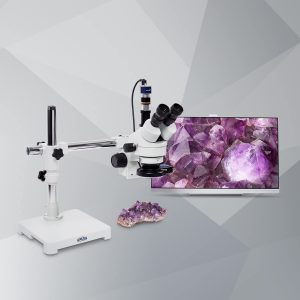
Zoom microscope with Swivelling arm
1.139,00 €Swivelling arm microscopes offer maximum working distance and flexibility. Ideal for viewing and precisely testing of set gemstones and minerals.
excl. VAT
+ Shipping costs
Add to cart -
Immersion microscope zoom
2.298,00 €Powerful stereo microscope with a large zoom range and long working distance, enabling observations with high technical prerequisites
excl. VAT
+ Shipping costs
Add to cart -
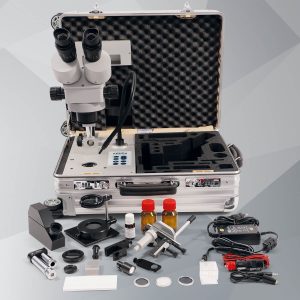
Large mobile gemstone laboratory KA52KRS
8.467,00 €Mobile gemstone laboratory in a case: premium equipment for professional gemmology – can be used anywhere, robust, flexible
excl. VAT
+ Shipping costs
Add to cart
Evaluating diamond colour: D–H (colourless to near colourless)
The more colorless a diamond, the more it reflects light and the higher its value. The GIA scale ranges from D (colourless) to Z (heavily tinted). Particularly rare and sought-after are the intensely coloured fancy diamonds such as pink, yellow or brown.
Carat - the Weight of the Diamond
The term carat is derived from the Arabic word “qirat” and refers to the seed of the carob tree. These seeds were long used as counterweights for gold and gemstones and were believed to weigh a consistent 0.2 grams. This still corresponds to 1.00 ct today. The weight alone does not determine the value – only the combination of all 4C’s provides a professional diamond assessment and forms the basis for value determination.
Another important evaluation criterion: fluorescence
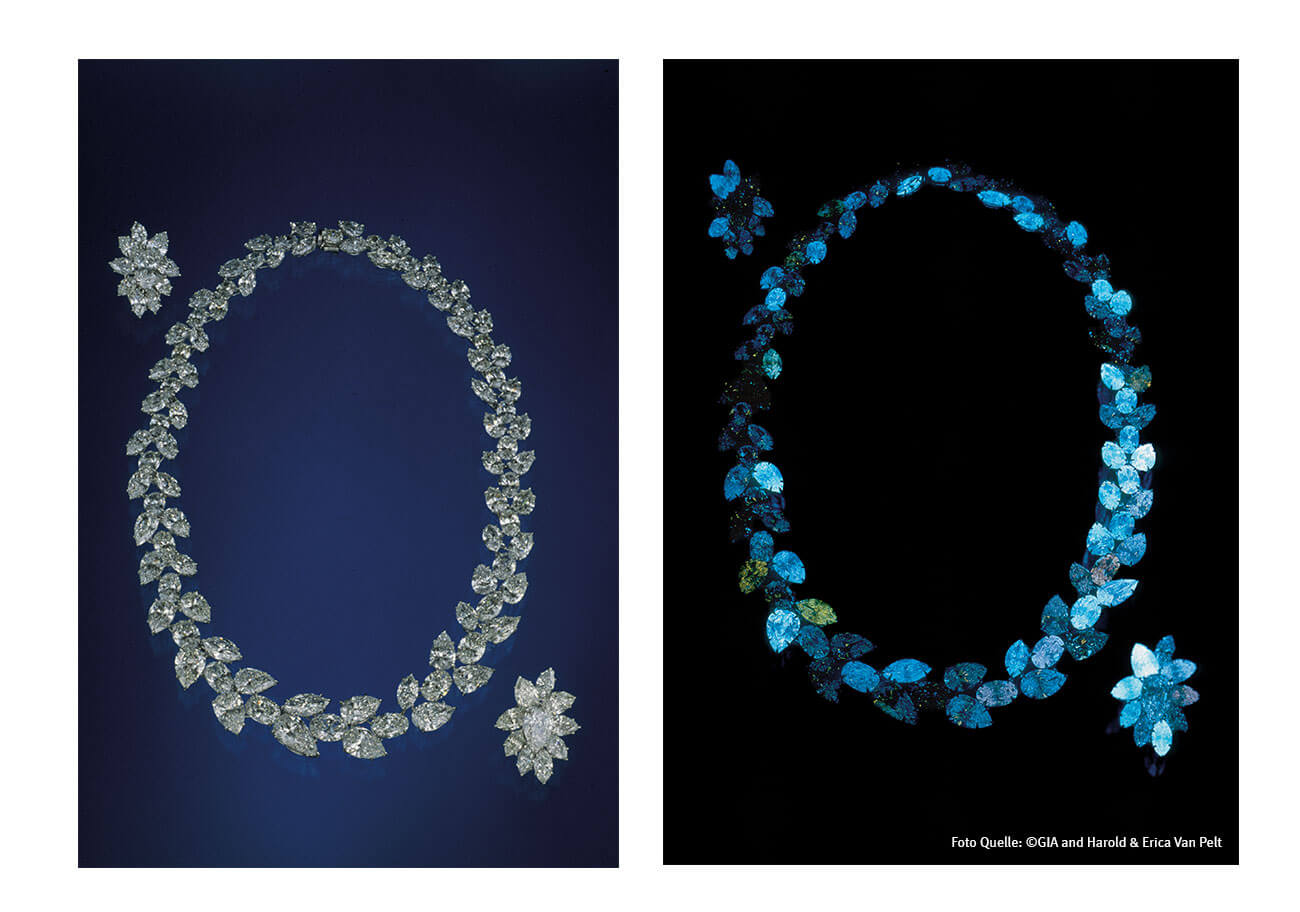
Strong to very strong fluorescence can lead to a reduction in value for diamonds of the highest GIA colour grades D to F. In extreme cases, the intense glow can create an oily or hazy optical effect that interferes with the impression of clarity.
- Detailed information about fluorescence behavior and our UV analysis lamps can be found in the two articles: Recognizing diamond forgeries under UV light and Investigation with UV light.
KRÜSS Gemmo-Shop: Example products UV analysis lamps
-
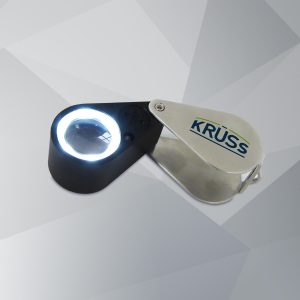
Triplet UV light loupe with LED / LUK10-21-UV-LED
55,00 €Triplet UV magnifier with LED (UV illumination), lens Ø 21 mm, magnification 10X, round shape
excl. VAT
+ Shipping costs
Add to cart -
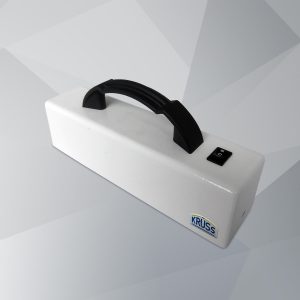
UV analysis lamp UV120
499,00 €UV analysis lamp (120 VAC) for checking gemstone solders. Works with different wavelengths to reveal luminescence phenomena.
excl. VAT
+ Shipping costs
Add to cart -
UV analysis lamp UV240
499,00 €For the simultaneous inspection of gemstone solders, works with different wavelengths and the disclosure of luminescence phenomena
excl. VAT
+ Shipping costs
Add to cart
Special feature: Synthetic diamonds or lab-grown diamonds (LGD)
Synthetic diamonds are currently very much in vogue. In fact, they are not new – they have existed since around 1956. While natural diamonds form deep within the Earth over millions of years under immense pressure and high temperatures, lab‑grown diamonds (LGD) develop within a matter of weeks in a laboratory. Using highly precise technologies, tiny diamond seeds grow in a controlled environment into sparkling crystals.
Visually and chemically, LGDs resemble their natural counterparts – but there is a clear difference when it comes to the value factor: naturally grown diamonds remain the more enduring choice due to their rarity, whereas LGDs stand out for their attractive prices and environmentally friendly production methods.