Gem microscope zoom

1.041,00 

excl. VAT

+ Shipping costs

Available from stock

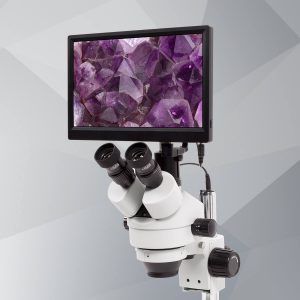
Powerful stereo microscope with a large zoom range and long working distance, enabling observations with high technical prerequisites

- +
Artikelnummer KSW5000-T-LED Kategorie Tags , , , ,

Delivery time: 14 days

Description

KSW5000-T-LED

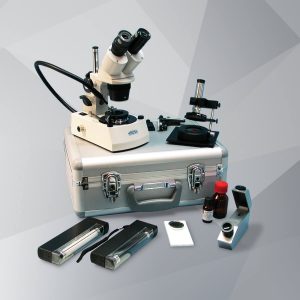
With its large zoom range, long working distance and high technical prerequisites, this powerful stereo microscope is perfect for examining gemstones, minerals and fossils. With incident and transmitted light, dark-field illumination (dark-field condenser) and rotatable stone holder.

Technical details

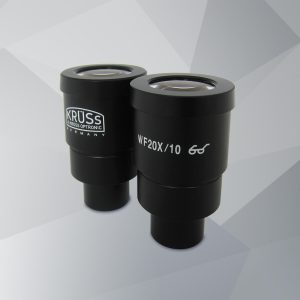
■ Stepless zoom with 7x-45x magnification, expandable to 14x-90x. Max. Magnification 180x (by using 20x eyepieces and auxiliary lens 2x as accessories)
■ With Phototube
■ High technical prerequisites
■ 45° oblique view, 360° rotatable
■ 10x wide field eyepieces incl. eyecups Eyecups, field number 20
■ Symmetrical eye distance adjustment 51-75 mm
■ Diopter adjustment on both sides
■ Object field 28.6-4.44 mm
■ Working distance: approx. 90 mm
■ Steplessly variable incident and transmitted light, dark-field condenser
■ Rotatable stone holder, specimen clamps
■ Glass and black/white contrast plate interchangeable

Why gemstone microscopes are indispensable for diamond valuation

KRÜSS gemstone microscopes provide gemmologists and dealers with a tool that goes far beyond the classic 10x magnification of a loupe. A certified assessment can create security for buyers, especially when purchasing particularly valuable diamonds. Only under a gemstone microscope can the fine features that determine the quality and price of a diamond be recognized.

You are currently viewing a placeholder content from YouTube. To access the actual content, click the button below. Please note that doing so will share data with third-party providers.

More Information

KRÜSS stereo microscopes in practice

Our gemmological specialist, Dimitri Zlatev, demonstrates how the 4C diamond evaluation (Cut, Colour, Clarity and Carat) is carried out. He explains in particular the five factors of clarity grading: inclusion size, number of features, inclusion position, type/nature of the inclusion, and relief/visibility.

All of Dimitri’s videos can also be viewed on our YouTube channel.

Recommended standards and quality criteria for diamond grading

Clarity grades FL/IF–VS (flawless to very small inclusions) are determined as follows:

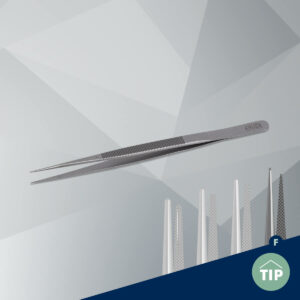
Almost every diamond contains natural inclusions. Stones with clarity grades FL appear flawless at 10x magnification, IF (Internally Flawless) are internally flawless and VS diamonds show very small, difficult‑to‑detect features. Experts use diamond loupes for the initial inspection. For professional grading or certification, our high‑quality stereo microscopes are widely used. For optimal handling during microscopy, we recommend using premium KRÜSS Optronic tweezers.

You are currently viewing a placeholder content from YouTube. To access the actual content, click the button below. Please note that doing so will share data with third-party providers.

More Information

KRÜSS stereo microscopes in practice

Untrained diamond assessment can lead to misdiagnosis. An experienced gemmologist knows the typical pitfalls – and Dimitri Zlatev demonstrates this impressively using the example of supposed inclusions.

The video reveals that the initial assessment of “inclusions” is misleading. In reality, there are multiple reflections in the pavilion facets that look like inclusions.

The result: what looks like a quality defect is actually an optical effect.

Background information on investigations using stereo microscopes or immersion liquid can be found in the methods article Microscopy.

Practical examples can be found in the articles: Examining inclusions with stereo microscopes (bright-field microscopy) and Examining under a dark-field microscope

You may also like…

Shopping Cart
Scroll to Top