
Anniversary event of the German Gemmological Society

Many top-class speakers spoke at the anniversary event of the German Gemmological Society. They highlighted current challenges and perspectives in gemmology. The audience was international: representatives of many gemmological societies from the USA (GIA), Great Britain (Gem-A), Switzerland, Belgium, Denmark, Finland, the Netherlands, Poland, Italy and Sri Lanka were present.

lecture-50-years-education-DGemG-kruess

Success factors for gemstone testing

Dr. Thomas Lind (President of the German Gemmological Society) is certain: “Now more than ever, comprehensive gemmological knowledge is a key success factor in the jewelry and gemstone industry.” There are various methods for testing gemstones. According to many experts, the equipment used for gemmological analysis has hardly changed in recent years. The reason: proven test procedures and the high quality of selected test devices. However, different requirements apply to the sector of detecting synthetically produced diamonds. Completely new methods are often used here.

Edlestein-Examination-Methods-Devices-2025-KRUESS

Gemmological devices from KRÜSS in gemstone testing

Methods for checking the authenticity of gemstones and diamonds are one of the central tasks in gemology. Methodical expertise is used to detect inclusions, color differences and refractions. Tools such as magnifying glasses, microscopes, polariscopes, dichroscopes, UV lamps and gemstone refractometers are available for analysis. Important: good results can only be achieved with the use of quality equipment. Gemmological instruments that KRÜSS has in its portfolio and that can be conveniently purchased in the online store.

German-Gemmological-Society-idar-oberstein-kruess

Testing synthetic stones

These are artificial stones, i.e. products manufactured in a laboratory by human hands. The chemical composition of the stones, their crystal structure and/or physical properties largely match those of their natural counterparts (natural gemstones).

Diamond clarity grade

Gemstone refractometer

Application - Gemstone Refractometer - Sapphire

Refractometers can be used to directly determine the specific light refraction (refractive index) of polished stones. The measurement of the refractive index is an important variable for determining the identity of gemstones as well as syntheses and imitations.

Identify composite bricks

These stones are crystalline or amorphous solids that have been joined together from two or more parts to form a single unit by bonding, melting or sintering. The individual parts can be gemstones, synthetic stones or imitations. Doublets consist of two parts, triplets of three parts.

Composite-stone-identify-KRUESS-gemmology

Unveiling Luminescence with UV Light

UV light is used, for example, to detect tampering. UV light can reveal composite stones, such as doublets and triplets. They consist of different components that react differently under UV light. In addition, UV light often reveals the adhesive used to hold them together.

Youtube-video UV light analyzing gemstones

Gemstone microscopes

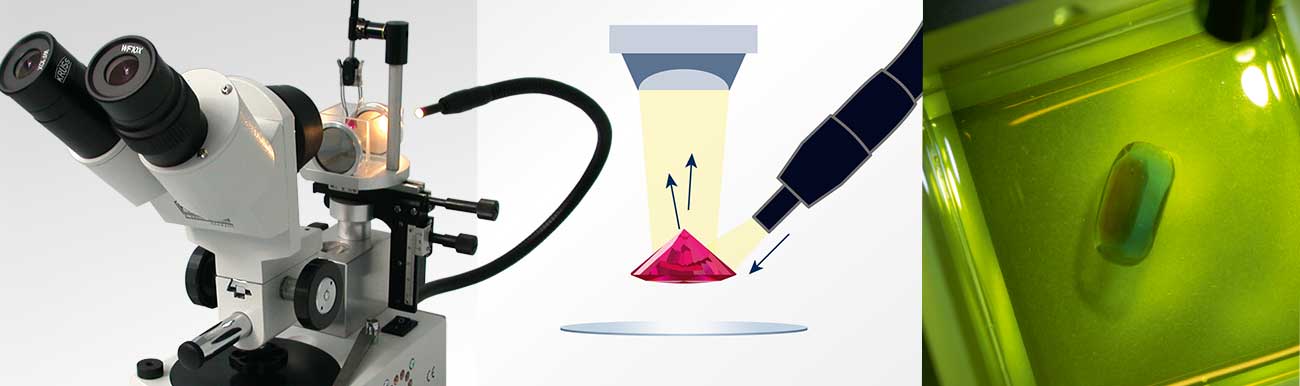
Function immersion microscopes

Microscopy in gemmology is used, for example, to visualize internal features such as inclusions. These are, for example, optically recognizable irregularities in the interior – such as material foreign bodies, minerals, liquids, gases, cracks, colour zoning or twin lamellae – the example above shows a composite imitation, a garnet-glass doublet under a KRÜSS microscope.

Recognize gemstone imitations

Imitations are imitations that only correspond to the gemstone model to be imitated in their external appearance (color, degree of transparency, etc.). However, they do not have the same chemical and/or physical properties and/or crystal structure.

Gemmology-Exhibitions-2023

Polariscope to view optical properties

These gemmological testing devices allow the rapid detection of common gemstone imitations, such as glass or synthetic spinels. This is done by investigating the optical properties of the stones with polarized light. Glass stones very often have internal stresses and then show anomalous anisotropy. They develop bright areas when viewed through a polariscope.

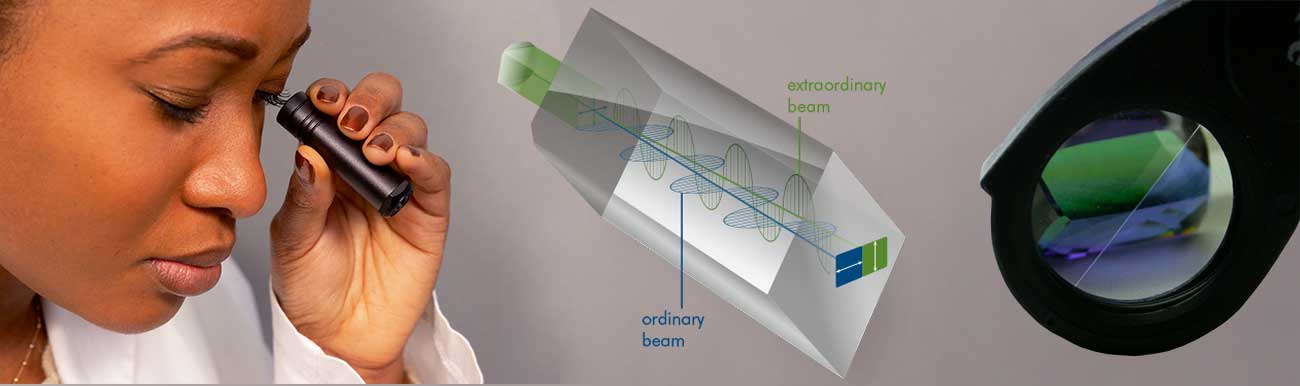
Dichroscope for observation of pleochroism

This gem testing analyzer is used to detect pleochroic colors (different colors that appear at different viewing angles). For example, if an emerald shows a different type of dichroism than the typed or expected one, this may be an indication of an imitation.

Dichroscopy: Reveal the direction-dependent polychromatism.

No matter for which examination or for which gemmological analysis you are looking for a test device. In the KRÜSS store you will find various test devices of the highest quality.

Shopping Cart
Scroll to Top